Prop Firms With Free Challenge Retries: Rules and Eligibility Compared

Failing a proprietary trading challenge does not always mean paying the full entry fee again. Some prop firms offer a free retry under specific conditions, while others provide a second attempt only through promotions, limited-use benefits, or paid resets. The differences can have a significant impact on the total cost of trying to qualify for a trading account.
The most important detail is what a firm means by “free retry.” One provider may grant another attempt only if you finish an evaluation in profit without reaching the target. Another may issue a replacement account after a rule breach, but apply stricter limits to the new attempt. A third may offer free resets only through giveaways.
This guide compares retry policies, explains the eligibility requirements traders should check, and shows how to distinguish a genuine free second attempt from a discounted reset or a refund that becomes available only after success.
Prop Firms and Their Retry Options at a Glance
The following comparison includes firms with documented retry mechanisms or publicly described routes to another attempt. Availability and conditions may change, so confirm the current rules for the exact account before purchasing. Editorial ratings reflect the usefulness and clarity of the retry option for this comparison, not the probability of passing a challenge or receiving a payout.
| Rank | Prop Firm | Best For | Markets | Challenge Types or Retry Route | Editorial Rating |
|---|---|---|---|---|---|
| 1 | FundedSquad | Traders seeking a defined, one-time retry benefit | Forex and CFDs; verify current product availability | One free retry on eligible evaluation accounts | 9.5/10 |
| 2 | FTMO | Traders who may finish an evaluation in profit without reaching the target | Forex and CFDs | Conditional free retry; verify current eligibility rules | 9.3/10 |
| 3 | Fundedelite | Traders comparing a built-in retry with adjusted retry conditions | Forex and CFDs; verify current product availability | One-step challenge with a free retry under specific rules | 9.0/10 |
| 4 | JadeFunded | Traders looking for a retry after a narrowly missed target | Forex and futures, subject to current program terms | One free near-miss retry under stated conditions | 8.8/10 |
| 5 | Leofins | Traders comparing evaluation structures and the full cost of another attempt | CFDs and a separate futures offering | Core 2-Step, Edge 1-Step, Starter 3-Step; verify current retry policy | 8.5/10 |
| 6 | Tradeify | Traders willing to watch for promotional reset opportunities | Futures | Free resets through giveaways, according to published third-party reporting | 8.0/10 |
These firms do not all provide the same benefit. FundedSquad describes a retry attached to eligible purchased evaluation accounts, while JadeFunded’s free retry is tied to a near-miss condition. Tradeify’s reported free-reset route is promotional rather than a standard benefit available to every trader.
Leofins is included as a comparison point for evaluation costs and program structure. A general free-retry entitlement could not be established from the information reviewed for this guide, so traders should not assume one is included. Always check the provider’s current terms before buying.
1. FundedSquad: A Free Retry for Eligible Purchased Accounts
FundedSquad describes a retry benefit for eligible evaluation accounts purchased from the qualifying date specified in its help documentation. The benefit provides a new account of the same size so the trader can attempt the failed stage again without paying an additional retry fee.
The key conditions include:
One retry per eligible account. It is not a separate retry for every evaluation phase.
A claim deadline applies. The help documentation instructs traders to contact support within 14 days of the breach.
Not every account qualifies. Promotional, giveaway, and certain instant accounts are excluded.
Retry rules may differ. The replacement account can have different targets, drawdown limits, or reward conditions from the original account.
This is an important example of why “free retry” does not necessarily mean “repeat the original challenge under identical conditions.” Read the replacement account’s terms before trading.
Who should consider it? Traders who value a documented second attempt and are comfortable with the specific rules that apply to the retry account.
2. FTMO: A Conditional Retry Route
FTMO is often discussed in connection with a conditional retry for traders who finish a challenge in profit but do not reach the required target. Eligibility and availability should be confirmed against FTMO’s current official terms before relying on this route.
The distinction matters because a profitable near-miss is different from breaching a daily or maximum loss limit. A trader who violates the account rules should not assume that the same retry option will be available.
Before purchasing, verify whether the selected challenge includes a retry provision, what the account’s final balance must be, and whether all trading objectives and restrictions must remain satisfied.
Who should consider it? Traders who want a structured evaluation and are checking whether their particular challenge offers a second attempt under qualifying conditions.
3. Fundedelite: A Retry With Different Conditions
Fundedelite’s published help documentation describes a one-step challenge with a free retry if the evaluation is breached. However, the retry is not simply a fresh copy of the original challenge.
The documented retry conditions include a lower maximum-loss allowance and a reduced reward share. This can make the second attempt more restrictive even though it does not require another challenge fee.
Review the current rules for the original evaluation and the retry account, paying particular attention to:
The profit target and daily loss limit.
The maximum-loss threshold after the retry.
Minimum profitable-day requirements.
The reward share and payout eligibility.
Any changes to the rules for the funded stage.
Who should consider it? Traders who value an included second attempt but can work within potentially tighter risk parameters and a different reward structure.
4. JadeFunded: A Retry for a Near-Miss
JadeFunded describes a free retry for traders who miss the profit target by no more than 0.5 percentage points without breaching a drawdown rule. The stated benefit is limited to one qualifying retry on the same tier.
Its published policy also describes a different cost structure for subsequent attempts. Because the initial challenge fee may be deferred until the first payout, traders should understand exactly when charges become payable and how later attempts are treated.
The key eligibility checks are:
The target shortfall must fall within the stated near-miss threshold.
No drawdown breach can have occurred.
The free retry is limited to the qualifying attempt.
Subsequent retries may incur a fee.
These conditions make the program different from a blanket free retry available after any failure.
Who should consider it? Traders who prefer a clearly defined near-miss provision and have verified the deferred-fee arrangement and subsequent retry costs.
5. Leofins: Compare the Cost of a New Attempt
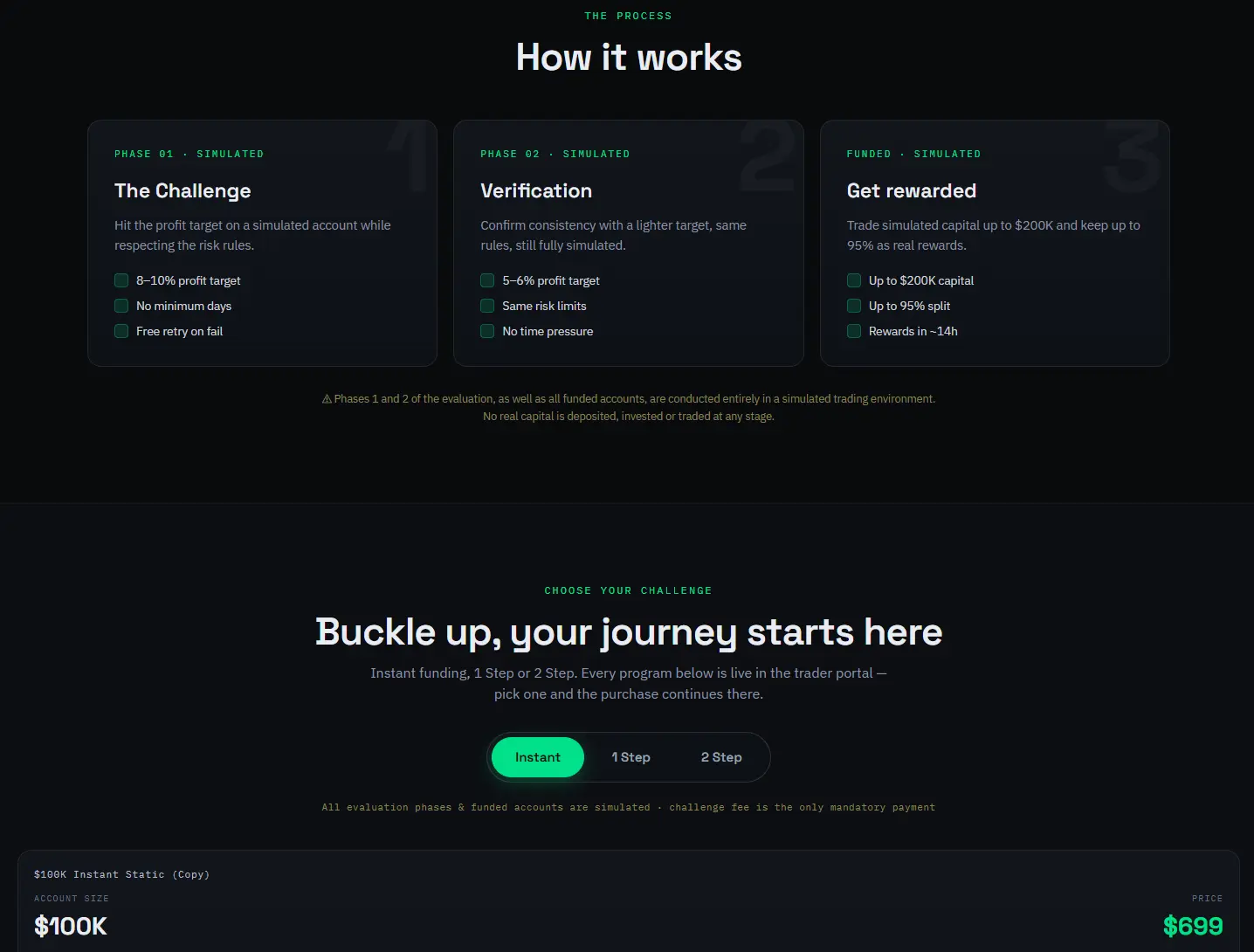 Leofins offers several evaluation structures, including Core 2-Step, Edge 1-Step, and Starter 3-Step, as well as a separate futures-oriented program. Each option needs to be assessed according to its own targets, loss limits, and payout conditions.
The information reviewed for this guide did not establish a general free-retry policy for Leofins. Therefore, traders should verify the current rules rather than assume a failed challenge automatically qualifies for another attempt without charge.
When comparing Leofins with firms that explicitly advertise free retries, consider the full financial picture:
The initial challenge fee and any additional charges.
The conditions for a fee refund after successful progression.
Whether a retry, reset, or new purchase is available.
The applicable drawdown and evaluation rules.
The timing and requirements for the first payout.
Review the current programs at leofins.com/ and confirm the retry policy with the provider before paying. A fee refund after qualifying for rewards is not the same as a free retry after failing an evaluation.
Who should consider it? Traders comparing multiple evaluation formats who want to assess entry costs, risk rules, and reward eligibility together rather than focusing on retries alone.
6. Tradeify: Promotional Free Resets
Tradeify has been reported as offering free resets through TradeifyTV giveaways. This is different from a standard policy that automatically grants a retry to every eligible customer who fails a challenge.
A giveaway-based benefit depends on whether a promotion is running and whether the trader meets its conditions. Do not base a purchase decision on the assumption that a free reset will be available later.
Check the official promotion details, including eligibility, the specific account types covered, deadlines, and whether the benefit is limited to one use.
Who should consider it? Futures traders who are already evaluating Tradeify’s regular program terms and happen to qualify for a current reset promotion.
Free Retry vs. Reset vs. Fee Refund
These three terms are often used interchangeably in marketing, but they describe different benefits.
| Feature | What It Means | Main Limitation |
|---|---|---|
| Free retry | Another attempt without an additional retry charge | Eligibility may depend on how the challenge ended |
| Reset | An account is restarted, sometimes for a fee | The reset may cost money and may change account conditions |
| Fee refund | The original challenge fee is returned after qualifying conditions are met | Usually depends on passing or reaching a specified payout milestone |
| Promotional reset | A free reset is offered through a time-limited promotion or giveaway | Availability may be restricted and temporary |
| Deferred challenge fee | The challenge fee is collected later, under the program’s terms | The fee has not necessarily been waived |
The difference is particularly important for budgeting. A refund after a successful payout does not help a trader who has failed and wants to try again. Similarly, a discounted reset still represents an additional expense.
What Usually Determines Eligibility for a Free Retry?
Before you purchase a challenge, look for the specific conditions that govern another attempt.
How the evaluation ended
Some retry policies are designed for traders who finish in profit but fall short of the target. Others apply after a defined rule breach. A promotion may cover only particular failure scenarios.
Read the policy’s exact wording. “Missed target,” “failed challenge,” and “breached account” are not necessarily equivalent categories.
Whether trading rules were respected
Some firms require the trader to stay within all loss limits to qualify for a retry. Others may offer a retry after a qualifying breach but exclude accounts closed by the risk team or for prohibited conduct.
Check whether inactivity, suspected rule violations, or an administrative account closure affects eligibility.
Which account or challenge was purchased
Retry benefits may apply only to specific evaluation types, purchase dates, or account sizes. Instant or promotional accounts may be excluded.
If you are comparing two challenge models from the same firm, do not assume that the retry terms are identical.
How quickly you must claim it
A free retry may not be issued automatically. Some firms require the trader to contact support within a specified period.
Keep a record of the breach date and follow the official claim process promptly. If you believe you qualify but cannot access the retry, contact the provider before buying another account.
Whether the second attempt has different rules
A retry may involve a new profit target, stricter drawdown limits, a lower reward share, or different minimum trading-day requirements.
Read the rules for the replacement account rather than relying exclusively on the original challenge’s conditions.
How to Choose a Prop Firm if Retries Matter to You
A free retry is useful only if the underlying program is suitable for your trading style. Compare the following factors in order.
First, check the normal evaluation rules. If the profit target and drawdown limits are unrealistic for your strategy, a retry may simply give you another opportunity to lose time and money.
Second, calculate the complete cost. Include the original fee, any subscriptions, activation charges, paid resets, and possible trading costs. Consider what you would pay if the retry were unavailable.
Third, check the retry conditions. Determine whether the benefit is automatic, conditional, promotional, or subject to a deadline.
Fourth, assess the replacement account. Confirm whether the same account size, targets, loss limits, and reward share apply.
Finally, decide what you would change after a failed attempt. A retry is most useful when you understand the reason for the first failure and have a practical plan to address it. If the problem was excessive position sizing or misunderstanding the rules, another account alone will not fix it.
Frequently Asked Questions
Does a free retry mean I can fail unlimited times?
Usually not. Many policies limit the benefit to one retry per account or restrict it to a qualifying failure. Any additional attempts may require a new purchase or a paid reset.
Can I get a free retry after breaching the daily loss limit?
It depends on the provider. Some programs allow a retry after a qualifying breach, while others require the trader to finish the evaluation in profit without reaching the target. Always check the specific eligibility conditions.
Is a free retry better than a challenge-fee refund?
They serve different purposes. A free retry may reduce the cost of another evaluation attempt, while a refund generally returns the original fee after specified success or payout conditions. Which is more useful depends on your circumstances and the exact rules.
Do I keep the same account balance and profit target on a retry?
Not necessarily. Some firms issue a replacement account with different drawdown limits, targets, minimum trading days, or reward terms. Review the retry account’s rulebook before placing another trade.
Should I choose a firm only because it offers free retries?
No. A retry is one factor in the comparison. Trading rules, platform access, evaluation costs, payout conditions, and the firm’s written policies should all be assessed together.
What should I do if a firm advertises a free retry but its terms are unclear?
Ask the provider for written clarification before paying. Confirm the qualifying failure conditions, any claim deadline, the number of retries available, and whether the replacement account uses different rules. Keep a copy of the applicable terms.
Choose the Rules, Not Just the Second Chance
A free retry can help limit the additional cost of an unsuccessful evaluation, but it is not a guarantee of passing or receiving rewards. The strongest policy is one that clearly explains who qualifies, what happens after failure, and whether the replacement account has different conditions.
Compare the normal challenge first, then treat the retry as an additional benefit. If a program is too expensive, too restrictive, or poorly matched to your strategy, the availability of a second attempt may not make it a sensible choice.
Prices and conditions are current as of October 2026.
Risk disclaimer: Proprietary trading evaluations involve financial risk. Challenge fees may be lost if an evaluation is unsuccessful or program rules are breached. Simulated trading and funded-program results do not guarantee future performance or income. Review the current terms carefully and never spend money you cannot afford to lose.